An AI company that makes pictures just built a medical scanner. No, really. On 18 June 2026, Midjourney — the lab known for turning text prompts into art — walked on stage in San Francisco and unveiled a full-body CT-style scanner. Not a new model. Not a new app. A physical machine you step into. Nobody saw it coming, and the reaction online was a collective "wait, what?"
If you only know Midjourney as the thing that generates dreamy artwork from a sentence, this is a hard left turn. So let's break down what was actually announced, what's real, and what you should take with a grain of salt.
The company launched a new division called Midjourney Medical and its first hardware product, the Midjourney Scanner — a full-body "Ultrasonic CT" device. CEO David Holz demonstrated it live and called it the first new whole-body imaging method in 50 years. Bloomberg, The Verge and others covered the pivot the same day, and Butterfly Network — whose chip technology the scanner is built on — confirmed the partnership on the record. So the event, the device and the partner are all verified, not a stunt.
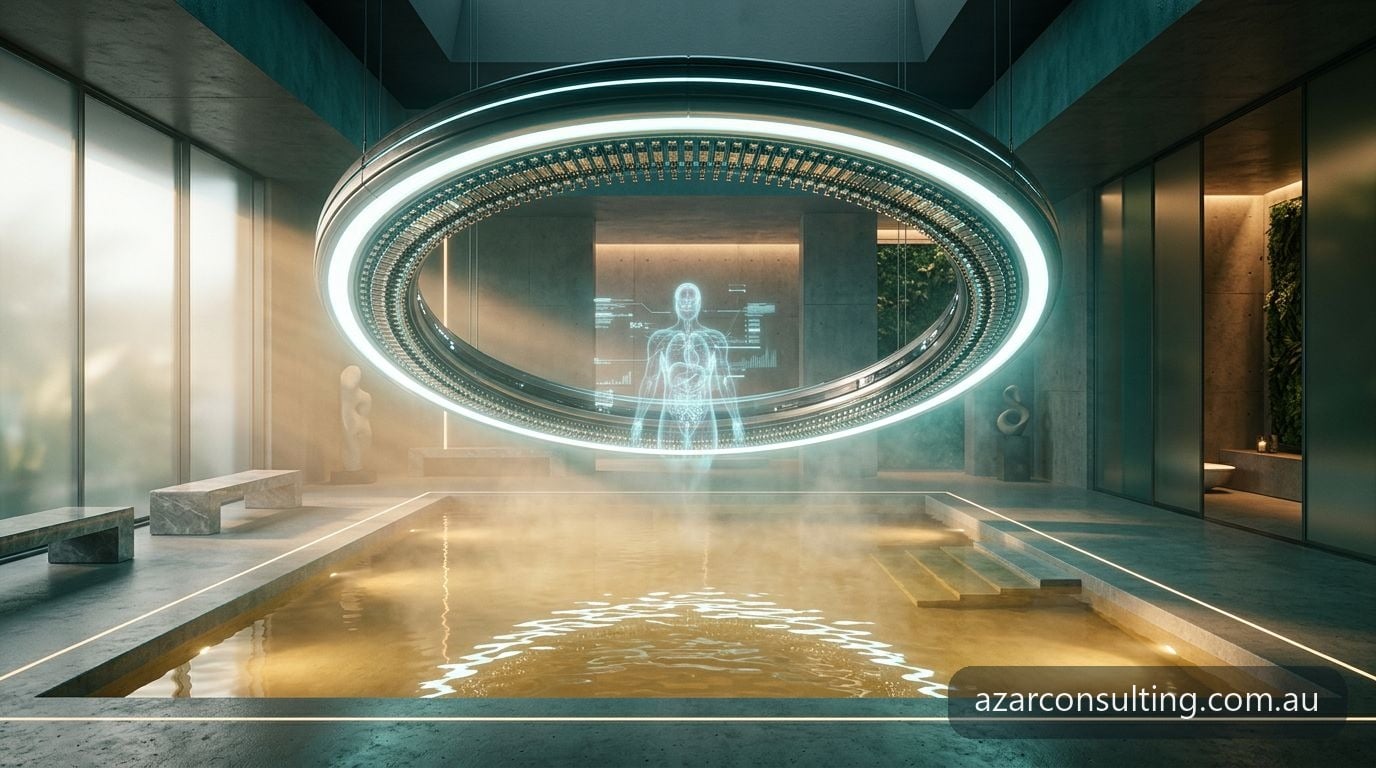
The pitch in one line: imaging "as powerful as MRI, as casual as a trip to the spa." The first deployment is planned as a 25,000 sq ft "Midjourney Spa" in San Francisco, opening end of 2027, with hot tubs, saunas, cold plunges — and the scanner quietly built in.
You step onto a platform that lowers you into a shallow pool of water at about 5 cm per second. As you descend, you pass through a ring of roughly 358,000 tiny ultrasound transducers — each acting as both a speaker and a microphone. They fire sound waves through your body from every angle and record how those waves change as they pass through skin, fat, muscle and bone. A compute cluster reconstructs that into a sub-millimetre 3D map of your insides.
No radiation. No heavy magnets. Target scan time: 60 seconds. And here's the genuinely surprising part — Holz was upfront that there's barely any AI in it yet. In his words, it's "just really cool hardware and software." AI is used to label and segment what the scan shows, but the imaging itself is ultrasound and signal processing.
This is where the consultant hat goes on. The device is real and was demonstrated live — but most of the eye-catching numbers are Midjourney's own claims from an early prototype, not independently verified results:
None of that makes it fake. It makes it early. The gap between "cool full-body images" and "safe, reimbursable, FDA-cleared diagnostic product" is exactly where this story will be won or lost.
The interesting signal here isn't the spa — it's the pattern. A software-native AI company with no investors and no hardware history just shipped a physical device by licensing the right chip technology and pairing it with serious compute. That's a template more AI labs will copy: take a frontier-software capability, point it at a stubborn real-world problem, and bridge the hardware gap through partnership rather than building everything in-house.
For anyone watching where AI is actually heading, that's the takeaway. The frontier is moving out of the browser and into the physical world — healthcare, sensing, infrastructure — and the companies doing it aren't always the ones you'd expect.
You can see the cinematic reveal and the technical walkthrough on Midjourney's official announcement page: midjourney.com/medical/blogpost.
Whether it becomes everyday infrastructure or an ambitious prototype that stalls at the FDA, one thing is certain: nobody had "AI art company builds a CT scanner" on their 2026 bingo card.