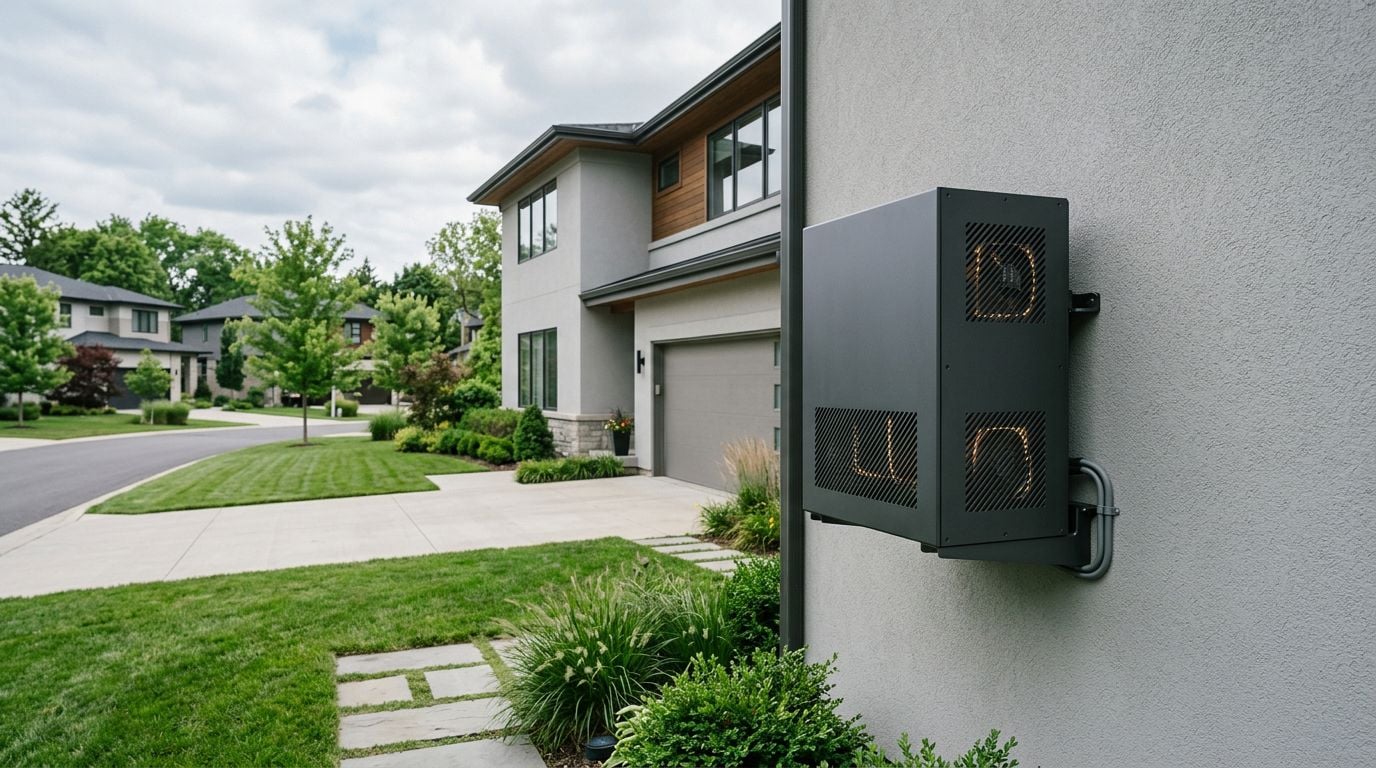
A San Francisco startup called Span, backed by NVIDIA, wants to put a piece of the AI cloud on the side of your house. The program is called XFRA, and the unit looks like an ordinary HVAC box bolted to the exterior of a home. Inside sits enterprise-grade GPU hardware running AI workloads for paying customers, quietly, in a residential neighbourhood rather than a purpose-built facility on the edge of town.
The arrangement is simple, at least on paper. Span installs the node at no upfront cost. In exchange for hosting it, the company covers a large share of the homeowner's electricity and internet bills. Some reporting points to a flat utility model of around 150 US dollars a month, other coverage describes Span paying the bills outright, and a few commentators have floated figures closer to 1,000 US dollars a month in value. The exact terms remain unconfirmed and may change before the program goes live, which is worth keeping in mind before anyone treats this as found money.
Each XFRA node is not a toy. Reports describe 16 NVIDIA RTX Pro 6000 Blackwell Server Edition GPUs, four AMD EPYC CPUs, and roughly three to four terabytes of memory, all liquid-cooled in a Dell server configuration. At current pricing, the GPUs alone represent well over 150,000 US dollars of hardware sitting beside a suburban home. This is the same Blackwell generation that sits behind NVIDIA's broader push to move heavy AI workloads into smaller form factors, scaled down from a warehouse into something the size of an air-conditioning condenser.
The workload target is AI inference rather than model training. Training needs thousands of GPUs working in tight coordination, with fast interconnects and very low tolerance for a node dropping offline. Inference, the act of running an already-trained model to answer requests, tolerates a far more distributed and loosely coupled setup. That distinction is the whole reason the home-node idea is plausible at all. A 16-GPU cluster is enough to serve a modest large language model, and a network of them could, in theory, be pooled to handle larger jobs.
The logic is about power, not chips. The main bottleneck to building new data centers is not money or silicon, it is getting enough electricity to the site and retrofitting the grid to deliver it. New substations and transmission upgrades can take years. Span's argument is that the spare capacity already exists, distributed across millions of homes that rarely draw anywhere near their full electrical allocation.
Span says the average home uses only about 40 percent of its allocated electrical capacity at any given moment, and almost never hits peak. Its smart electrical panels, the product the company was already known for before this venture, detect that spare headroom and steer it to the GPUs, drawing on power that has effectively already been provisioned to the property. The node throttles itself around the household, so in Span's telling your appliances are never starved to keep the GPUs fed.
Span claims this lets it deploy capacity roughly six times faster and at about a fifth of the cost of a traditional 100-megawatt facility. It is working with homebuilder PulteGroup to trial nodes at new homes, with a pilot of around 100 units planned for 2026 and stated ambitions to scale to tens of thousands of units and gigawatt-scale capacity from 2027. The early prototype deployments are in Northern California.
It is an elegant idea on paper, and almost entirely unproven in the field. As of the latest reporting, Span had installed only a handful of prototype units beside real homes, and one of its own partners confirmed a single live installation. The company has not published technical studies showing that its distributed approach is fast or robust enough for production AI traffic, where latency, uptime, and consistency all matter to the customer renting the compute.
There are practical concerns beyond raw performance. Grid experts have warned that a single street with several active nodes could force a large, concentrated load onto a local transformer, the kind of stress that degrades infrastructure faster and can push costs onto everyone in the area. That is precisely the complaint already levelled at conventional data centers, and shrinking the box does not make it disappear. Security is another issue, given each GPU is worth around 10,000 US dollars and the unit sits outside the home where it is an obvious target for theft. And the broader public backlash against data centers, including noise lawsuits from residents living near existing sites, does not soften simply because the hardware is smaller and closer to where people sleep.
Whether or not XFRA succeeds, it is a useful signal. The industry is hungry enough for inference capacity that putting server-grade GPUs in residential yards is now a serious commercial proposal rather than a thought experiment. Distributed inference at the edge, physically closer to the people actually using AI services, carries real latency advantages if the reliability and coordination problems can be solved. It is a genuinely different bet from the prevailing strategy of building ever-larger centralised campuses.
For Australian businesses, the direct relevance is limited for now. This is a United States trial, tied to a specific homebuilder and a particular grid and regulatory context that does not map cleanly onto the Australian market. Nobody here will be offered an XFRA box this year. The indirect relevance, though, is larger and more durable. The same two forces driving XFRA, namely constrained power and surging inference demand, are exactly why local and on-premise inference keeps getting cheaper and more capable.
A business that wants control over its AI workloads, for cost, latency, or data-sovereignty reasons, does not need to wait for a box to appear on its wall. The hardware to run capable models in-house is already here, and the economics keep improving with each GPU generation. XFRA is a glimpse of how far the market is willing to go to find capacity, and a reminder that the centre of gravity in AI infrastructure is still very much in motion.
XFRA is a clever response to a real bottleneck, wrapped in genuine uncertainty about whether distributed home compute can carry production AI workloads at scale. It is worth watching as a barometer of how desperate the market is for capacity, rather than as something to sign up for today. If the 2026 pilot delivers, it changes the conversation about where compute lives. If it stalls, it still tells you how acute the shortage has become.