Most AI weather models are trained on the same public datasets and then assimilate analyses published every six hours by ECMWF or NOAA. WindBorne Systems took a different route. It built its own atmospheric data collection layer first, then put a deep learning model on top of it. The combination is what produces the results, and it is worth reading as an architecture decision rather than a weather story. Their site is here if you want to follow the detail.
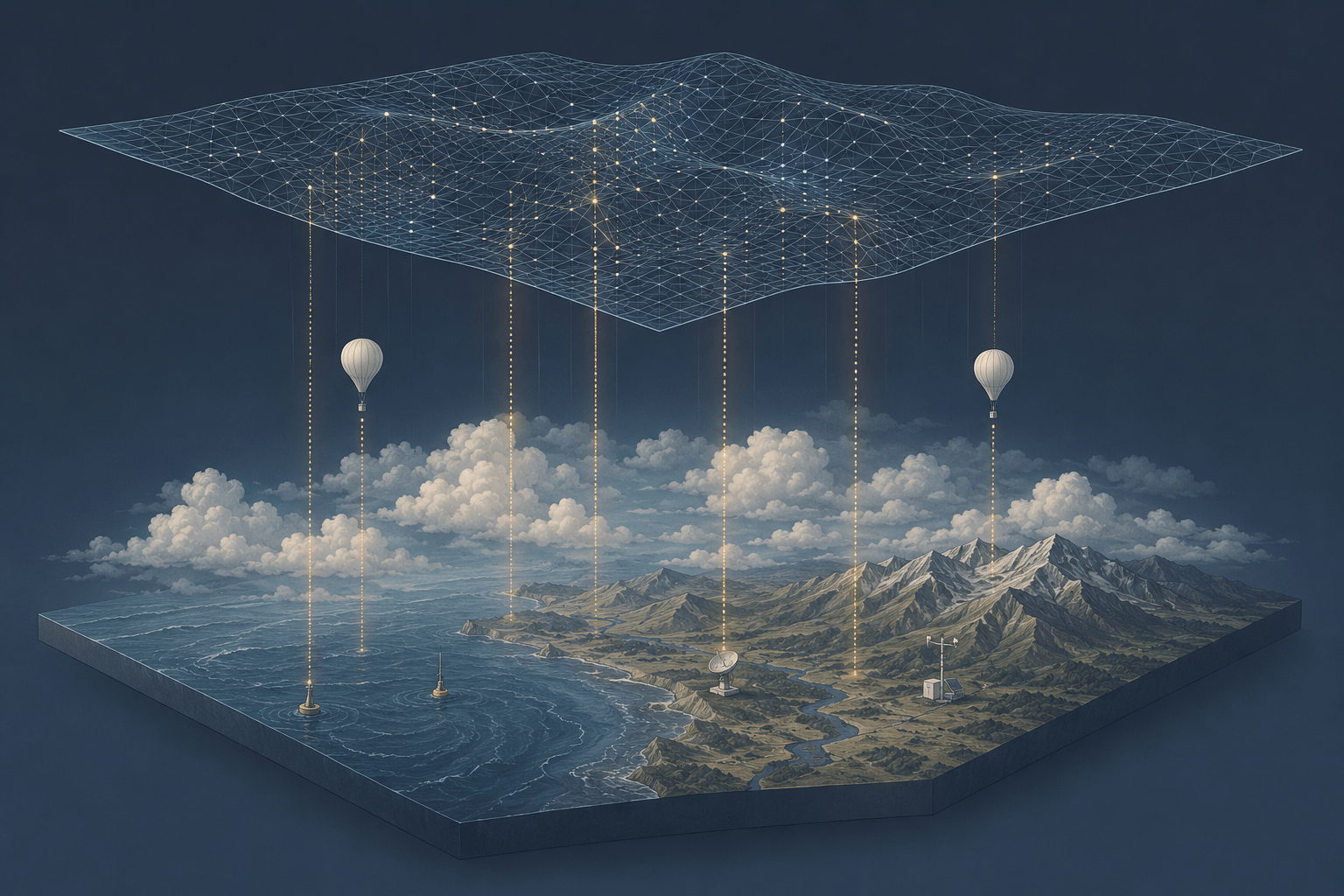
Around 85 percent of the atmosphere is under-observed for forecasting, with the worst gaps over oceans, polar regions, and remote areas where major weather systems form. A traditional radiosonde gives one short vertical profile over a couple of hours from a fixed launch point, then the balloon bursts. That is the raw material most models have to work with.
WindBorne operates a constellation it calls Atlas, built from long-duration Global Sounding Balloons. Each balloon weighs about 1.2 kg, can control its own altitude between the surface and roughly 20 km, and stays aloft for weeks rather than hours. Some flights have circumnavigated the globe more than once. A single balloon collects on the order of 50 vertical profiles per flight, and the company reports gathering far more data per dollar than conventional balloons can. The result is a stream of in-situ measurements from places no fixed station reaches.
This is the part to pay attention to. The hard, expensive, slow-to-copy work is the sensing network, not the model that reads from it. The data is proprietary, physically gathered, and accumulates into an asset that competitors cannot simply download.
WeatherMesh is WindBorne's deep learning forecast model. Traditional numerical weather prediction simulates the physics of the atmosphere step by step, which is accurate but needs a supercomputer running for hours. WeatherMesh instead learns a compressed internal representation of the atmosphere, often described as latent space, and evolves that representation forward in time. Running inference rather than full physics simulation is why it produces a global forecast many thousands of times faster than the traditional approach.
The current version, WeatherMesh-6, was announced on 1 June 2026. WindBorne reports it as the most skillful medium-range model they evaluated, AI or physics-based, running at roughly 25 km resolution. Over an evaluation window from July 2025 to March 2026 they report up to 38 percent lower ensemble-mean error than ECMWF's IFS and up to 32 percent lower than AIFS. The figure that lands hardest is on near-surface temperature: they report a 4.5-day WeatherMesh-6 forecast matching the accuracy of a 1-day forecast from IFS. Since operational forecasting has historically gained about one day of lead time per decade, that is a large jump by the standards of the field.
A separate 3 km version targets fine detail over land. WindBorne reports it beating NOAA's HRRR on surface temperature and wind against ground observations at every forecast hour past zero, while extending the horizon to 72 hours and refreshing every 15 minutes. These are the company's own published benchmarks, so they are worth reading alongside independent results, but the direction is consistent across sources.
Traditional global models run four times a day, so for most of the day the public forecast is already hours out of date. Because WeatherMesh runs its own data assimilation rather than waiting for ECMWF or NOAA analyses, WindBorne produces a fresh global forecast every hour. Each hourly run folds in another hour of observations, and accuracy improves with each one. The earliest run of a cycle already beats the established models, and the gap widens as later runs ingest more recent data, all of it landing before the major operational models publish.
The assimilation system itself ingests 11 distinct observation types, including microwave and infrared satellite sounders, and encodes WindBorne's own balloon readings by feeding the model the difference between what a balloon measured and what the forecast expected at that point. That lets the model learn efficiently from a growing but still limited history of its own unique observations.
The commercial structure is the interesting bit. NOAA, the US Air Force, and the US Navy buy WindBorne's balloon data, and that data is distributed internationally and assimilated into the US Global Forecast System. So WindBorne supplies the same agencies whose forecasts WeatherMesh competes against. Independent NOAA studies have found that adding even a small amount of WindBorne data measurably reduced tropical cyclone track error.
That dual position is more durable than a better model on its own. A model architecture can be reproduced, and the whole field is moving quickly. A physical network of sensors collecting data nobody else has is far harder to replicate, and it keeps the company useful to its competitors even in the scenario where someone else builds a better model.
The general lesson sits underneath the weather balloons. In a lot of AI products, the model is the least defensible component, because the same architectures and open datasets are available to everyone. For a startup, betting the company on a model edge is betting on something a better-funded competitor can copy in a release cycle. A proprietary data source feeding that model is usually where the real moat lives. WindBorne is a clean example: the forecasting wins trace back to observations it physically goes out and collects.
Getting to that kind of data means building hardware that collects it reliably, which is a discipline of its own. It spans electronics, firmware, power and connectivity, and the software pipeline that turns raw readings into something a model can use. That full path, from a sensor in the field to usable data, is the work behind our Smart Devices service.