For years, AI agents have been invisible. They sit behind chat windows, process tasks in the background, and communicate through text. Even the most capable ones operate as faceless utilities. You type into a box. You get text back. The agent itself has no presence.
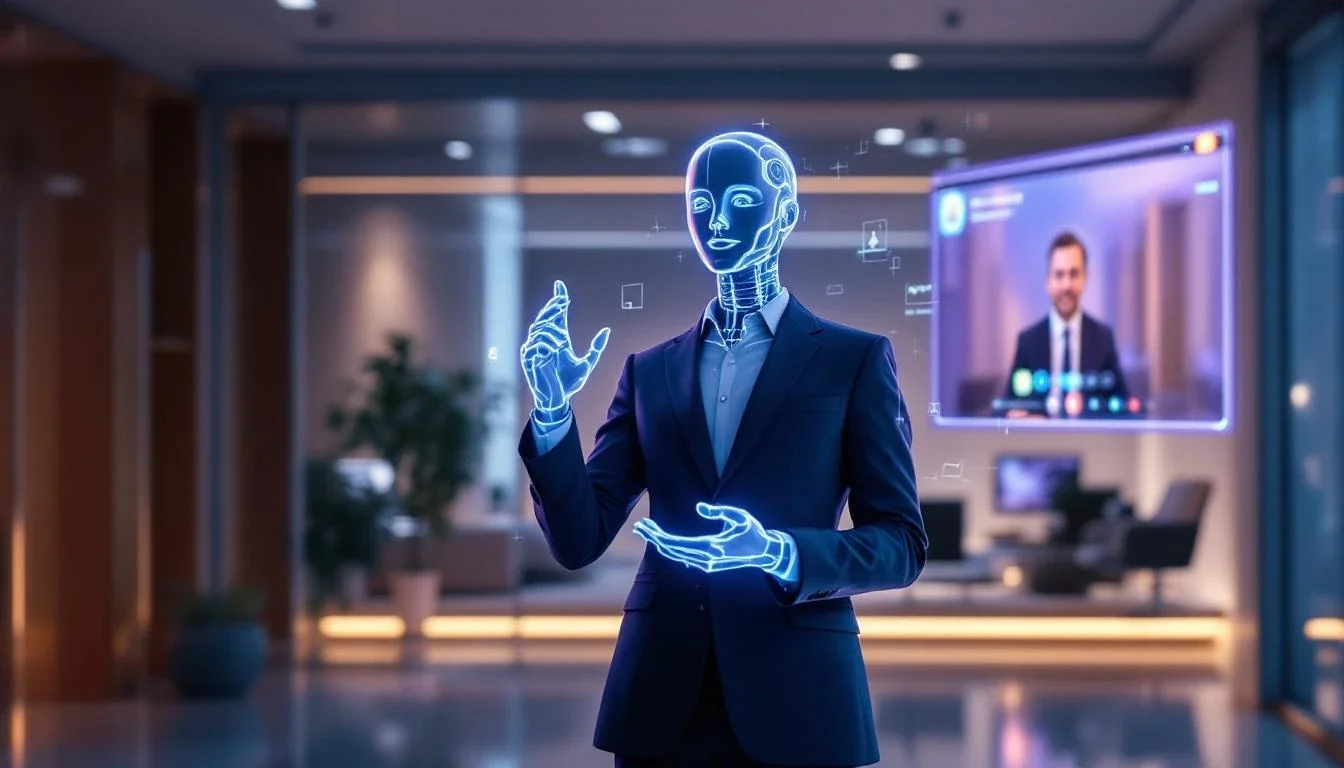
That is starting to change. A platform called pika.me — built by Pika Labs, the company behind one of the more popular AI video generators — is letting people create what they call an "AI Self." You give it your face, your voice, your personality, your expertise, and it builds a persistent digital agent that can show up in a Google Meet, reply to your WhatsApp messages, create content in your style, and maintain memory across every interaction. It is not a chatbot with a profile picture. It is an AI entity that participates in live conversations as a visible, speaking, reacting presence — generating video at 24 frames per second with roughly 1.5 seconds of latency. This shipped in April 2026. And it is part of a broader shift that anyone running a business should be paying attention to.
Pika Labs took its core capability in real-time video synthesis and applied it to a different problem: giving an AI agent a human-like presence that people can interact with face-to-face.
The onboarding captures your identity across multiple dimensions — photo, voice clone, personality description, communication style, expertise, boundaries. The system then builds an AI agent that reflects all of this and evolves over time as you train it.
The technical backbone is PikaStream 1.0, a 9-billion parameter Diffusion Transformer purpose-built for real-time video generation. It runs speech recognition, LLM reasoning, text-to-speech, and video generation concurrently — producing a live, lip-synced, expressive avatar that reacts to conversation as it happens on a single H100 GPU.
Once built, your AI Self can join live video calls on Google Meet (Zoom and FaceTime coming) as an animated avatar that listens, speaks, reacts with facial expressions, and can execute tasks mid-call — scheduling follow-ups, looking up files, drafting documents. It operates across iMessage, WhatsApp, Telegram, Discord, Slack, Signal, Google Chat, LinkedIn, X, Instagram and more, handling DMs and FAQs in your tone around the clock. It creates content — text, images, video, audio — using a stack of underlying models including Gemini, Veo 3, Sora, ElevenLabs, and others. It maintains persistent memory across sessions, remembering your preferences, projects, and relationships. And it can communicate in languages you do not speak.
The developer angle matters too. PikaStream 1.0 is open-source on GitHub. Any AI coding agent can be given a visual, vocal meeting presence through this skill. It is explicitly agent-agnostic — you do not need to buy into Pika's ecosystem.
If you run a small business or consultancy, your biggest constraint is that there is only one of you. Clients want your judgment, your experience, your communication style. But you cannot be in two meetings at once, answer enquiries at 3 AM, and create content simultaneously.
The digital representative changes this by handling interactions that do not require your full creative or strategic engagement.
Every consultancy has a front door problem — repetitive "tell me about your services" conversations that are important but time-consuming. A well-trained AI Self that can have this conversation naturally, in your voice, with your knowledge, and hand off qualified leads to you is a genuine productivity unlock. It is not a contact form. It is a version of you that can actually answer the questions.
Then there are the meetings you attend but do not need to. Status updates. Progress check-ins. Initial discovery calls where you are mostly answering standard questions. If your AI Self can attend these with your face, your voice, your project knowledge — take notes, answer questions, send you a summary — you have recovered hours of your week. These meetings are not unimportant. They matter for relationships. But they do not require your full cognitive engagement, and right now they get it anyway because there is no alternative.
The timezone problem is real too. If you are in Sydney and a prospect in London wants an introductory call, someone is taking it at an inconvenient hour. A digital representative that handles initial conversations asynchronously — in the prospect's timezone, potentially in their language — means you wake up to a summary and a qualified lead instead of setting an alarm for 11 PM.
The shift from invisible assistants to visible representatives is happening across the industry. Read AI launched Ada — a "Digital Twin" that gets CC'd on your emails and autonomously handles replies, scheduling, and questions using your calendar and company knowledge. Double AI offers "Identity Agents" that run product demos, screen candidates, and book meetings to your calendar. NTT's R&D division is working on "Human Digital Twin Computing" that captures skills, personality, and decision-making patterns into a digital replica.
Deloitte's 2026 AI trends report frames it plainly: agentic AI is the defining trend of the year — the shift from "AI that helps you" to "AI that works for you." Digital representatives are the natural visual layer on top of that. When your agent can not only execute tasks but show up and communicate as you, the distinction between assistant and representative disappears.
You own everything it says. If your digital representative makes a commitment you did not authorise or misrepresents your expertise in a client meeting, that is your problem. AI models hallucinate. Memory systems drift. Your carefully crafted personality profile does not prevent the underlying model from occasionally generating something you would never say.
Transparency is not optional. If someone discovers they were talking to your AI and did not know, you have a trust problem no technology can fix. In regulated industries the compliance implications are significant and untested. Even outside regulation, the reputational risk is substantial.
It is beta technology. PikaStream 1.0 shipped as a beta in April 2026. The performance is impressive on paper but this is early-stage technology in the most demanding context — live human interaction where every glitch is visible. Expect rough edges now and significant improvement over the next 12 months.
Your data is the product. You are uploading your face, voice, personality, and potentially client knowledge to a third-party platform. Understand what is stored, how it is used, and what happens if you want to delete everything.
Experiment now, deploy later. Build your AI Self. Put it in a Google Meet with a colleague, not a client. Understand what it actually does versus what the marketing says.
Identify your delegation candidates. Map the interactions that consume time but do not require your full engagement — initial enquiries, FAQ conversations, status meetings, content drafting.
Set boundaries before you need them. Define what your AI Self can and cannot say, what commitments it can make, and what triggers an escalation to you. Treat it like onboarding a team member.
Be transparent. If you use a digital representative, say so. The upside of early adoption is being seen as forward-thinking. The downside of deception is being seen as untrustworthy.
The invisible AI assistant era is ending. The AI digital representative era is starting. The question is not whether this becomes mainstream — it is whether you will have figured it out by the time it does.