Every few months, the AI world gets another launch that is supposed to change everything. Usually it is a new model, a new funding round, or a new product page explaining how the future has arrived again. Most of it disappears into the same noise. That is part of why PewDiePie’s Odysseus project is getting attention. It does not feel like another polished software announcement from a venture-backed company trying to win the enterprise dashboard wars. It feels like something stranger and, in some ways, more important: a mainstream internet figure taking the local-first AI idea and putting it in front of a very large audience.
That alone would be enough to generate curiosity. PewDiePie has reach, and anything he puts his name on will draw a crowd. But Odysseus is not getting attention only because it comes from one of the most recognisable creators on the internet. It is getting attention because it touches a nerve that has been sitting underneath the AI boom for a while now. A lot of people like what modern AI can do. A lot fewer people are comfortable with how dependent that experience has become on cloud platforms, subscriptions, closed systems, and the quiet assumption that your data should live inside someone else’s machine.
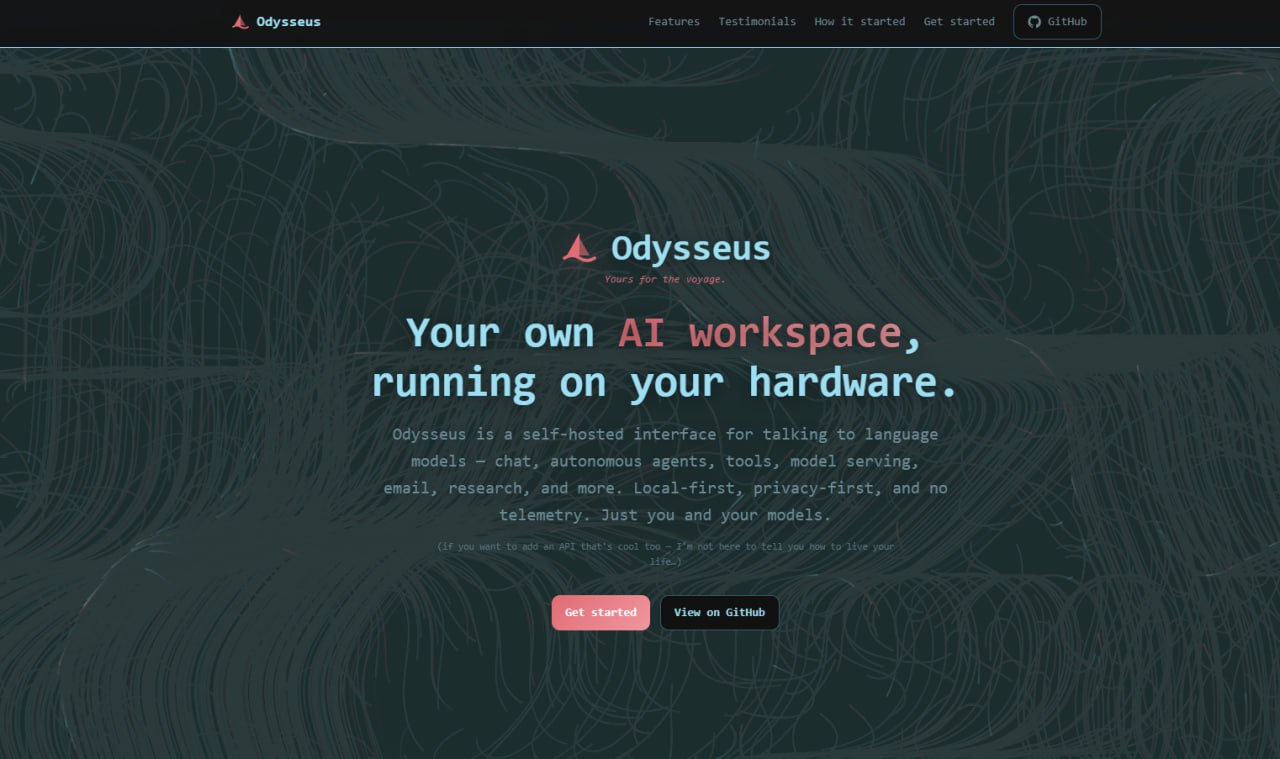
Odysseus is aimed directly at that discomfort. It is described as a self-hosted AI workspace, which is a much more interesting description than “chatbot” or even “assistant.” The idea is not simply to give people another place to type prompts. The idea is to create a single environment where chat, agents, research, memory, tools, documents, email-style workflows, and model serving all live together under the user’s control. In other words, it is trying to package the messy, fragmented world of local AI into something that feels coherent enough for normal people to actually use.
That is the first reason people are paying attention. Odysseus is not selling a smarter sentence machine. It is selling a different relationship with AI.
Timing is doing a lot of work here. AI has already moved past the stage where the public is simply amazed that a machine can answer questions. That novelty phase is largely over. The conversation is shifting toward control, trust, cost, and dependency. People are starting to ask harder questions. If AI becomes part of daily work, where does the context live? Who owns the conversations? What happens when a subscription goes up, a feature disappears, or a provider decides your workflow no longer fits its business model?
For developers, hobbyists, and privacy-conscious users, those questions have been around for a while. They are already familiar with self-hosting, open-source tools, local models, and the trade-offs involved in running things on your own hardware. But that is still a niche conversation compared with the broader consumer market. What PewDiePie has done is drag a version of that niche conversation into mainstream creator culture.
That matters because most technology shifts do not go mainstream when engineers declare them interesting. They go mainstream when someone with cultural gravity makes them feel legible. Odysseus may not be the most advanced technical project in local AI. It may not even be the cleanest. But it has done something a lot of technically stronger projects have failed to do. It has made local AI feel visible, accessible, and worth talking about outside developer circles.
That is a bigger move than it may look at first glance. There are plenty of good open-source AI tools. Most of them never escape the bubble of people who already know why they should care. Odysseus is different because it is crossing into a much wider audience, and that changes the conversation around what AI products can be.
One of the more interesting things about the Odysseus pitch is that it is not really competing on raw intelligence. It is not making the usual claim that it is better than every major model on earth. Instead, the appeal is philosophical and practical at the same time. The promise is that your models, your data, your files, and your workflows can live with you rather than being continuously piped into a remote platform you do not control.
That message lands because people are tired. They are tired of subscriptions for basic digital functionality. They are tired of software that gets worse after every redesign. They are tired of handing over more personal context in exchange for convenience and then being told that privacy concerns are a niche issue. They are tired of building a workflow around a product only to discover that the product owner has changed direction.
Odysseus taps directly into that mood. Its appeal is not just “AI, but private.” It is “AI, but on your terms.” That is a subtle difference, but an important one. Privacy is part of the story, though not the whole story. The bigger attraction is ownership. Ownership of setup. Ownership of context. Ownership of the machine that actually runs the thing.
That does not mean local-first AI is automatically simple or frictionless. It is not. Self-hosting comes with setup overhead, hardware constraints, maintenance, and security responsibilities. But people are increasingly willing to accept friction if the payoff is independence. That is the same reason self-hosted media servers, password managers, note systems, and home labs have grown in popularity. People are not always choosing the easiest path. Sometimes they are choosing the path that feels less extractive.
Another reason Odysseus is getting attention is that it appears to have real scope. This is not a rough GitHub repo with a cool idea and no follow-through. The public materials point to an actual workspace with multiple moving parts: chat, agents, tools, research flows, model serving, memory, comparison features, and more. There is Docker support, platform setup guidance, bundled services, and documentation that suggests this was built with real usage in mind rather than just announcement energy.
That does not mean it is finished, polished, or guaranteed to become a durable platform. Early attention is not the same thing as long-term success. But there is a big difference between a creator attaching their name to a concept and a creator shipping something with enough structure that people can install it, inspect it, fork it, and argue about it in practical terms.
The open-source element matters here too. The fact that people can look at the repository, assess the architecture, open issues, submit pull requests, and discuss the implementation gives the project a different kind of legitimacy. It stops being pure branding. It becomes something the internet can actually touch.
And once that happens, the attention becomes more durable. Instead of one launch-day reaction cycle, you get secondary waves: developers reviewing the code, hobbyists testing installs, critics pointing out weak spots, supporters improving documentation, and commentators debating whether this is the beginning of a broader shift. That kind of participation is one of the reasons open-source projects can punch above their weight culturally.
It is tempting to frame all of this as a celebrity project story. In one sense, that is true. PewDiePie’s name is the reason many people heard about Odysseus in the first place. But the more useful way to think about it is distribution. Technical communities often assume the best product wins attention. In reality, what often wins attention is the product that reaches people before they have a settled opinion.
PewDiePie has that ability. He can take an idea that would normally circulate among AI enthusiasts, Linux users, and open-source builders, then move it into front-facing internet culture. That creates a bridge between worlds that do not usually overlap very much. Suddenly, people who might never have looked at self-hosted AI are seeing it as something concrete rather than abstract.
That is why this launch has a different feel from the average AI tool announcement. It is not just another company trying to acquire users. It is a large creator shaping public imagination. He is not only saying that private, local AI is possible. He is making it seem desirable. That may end up being the most consequential part of the whole project.
If enough people start thinking of AI as something they can run, customise, and own, rather than something they rent from a remote provider, that changes the direction of the market. It creates demand for better local tooling, easier setup flows, clearer security practices, and more serious work on user-controlled AI environments. Even projects that compete with Odysseus could benefit from the shift in attention.
None of this means the excitement should go unquestioned. In fact, one reason Odysseus is interesting is that it sits right in the tension between empowerment and risk. A self-hosted AI workspace with access to tools, files, web research, memory, email-like systems, and possibly shell-level capabilities is not a toy. It is closer to an admin console than a consumer app. That is useful, but it also changes the threat model.
If people are inspired by the local-first message but ignore the operational side, they can get themselves into trouble. Running powerful software on your own machine is not automatically safer just because it is local. Safety depends on how it is configured, what permissions it has, whether authentication is enforced, how exposed it is to the network, and how well the user understands what they are actually running.
That is the part of the conversation that tends to get lost in launch excitement. Control is valuable, but control also means responsibility. The good version of this trend is more people learning how to use AI tools on their own terms. The bad version is people deploying systems they do not understand because creator excitement made it feel plug-and-play when it really is not.
That caution does not weaken the story. If anything, it strengthens it. Serious tools should be treated seriously. One of the reasons Odysseus is getting attention is that it is aiming at something more ambitious than prompt boxes and novelty wrappers. Ambition is attractive, but it comes with weight.
The bigger signal here is that AI products are slowly being pulled in two directions at once. One direction leads toward larger cloud platforms that want to become universal assistants inside managed ecosystems. The other leads toward personal AI environments that behave more like owned infrastructure. Odysseus belongs firmly to the second camp.
That camp will not replace the first one overnight. Most people will still prefer convenience, managed services, and a subscription they do not have to think too hard about. But the growth of local-first tools suggests the market is not as settled as big platforms would like it to be. There is room for a different vision, one where the user’s machine matters again, where context stays closer to home, and where AI is not only something you access but something you run.
That is why Odysseus is getting attention. Not because it is guaranteed to dominate. Not because PewDiePie suddenly became the central figure in AI. And not because the world desperately needed another chatbot headline. It is getting attention because it packages a deeper frustration and a different ambition into a form people can actually see.
For years, the dominant internet model has been simple: your data goes elsewhere, your tools live elsewhere, and your leverage disappears the moment you rely on them too much. Odysseus is appealing because it pushes against that model. Whether it becomes a lasting platform or just a very loud milestone, it has already done one important thing. It has made a lot more people ask whether AI really has to work the way big tech says it should.
That question is worth paying attention to, even if Odysseus itself ends up being only part of the answer.
Want help making sense of where AI products are heading, and what trends actually matter for business beyond the hype? Get in touch with us to talk through the opportunities, risks, and practical decisions. We’ll help you separate durable shifts from launch-day noise.