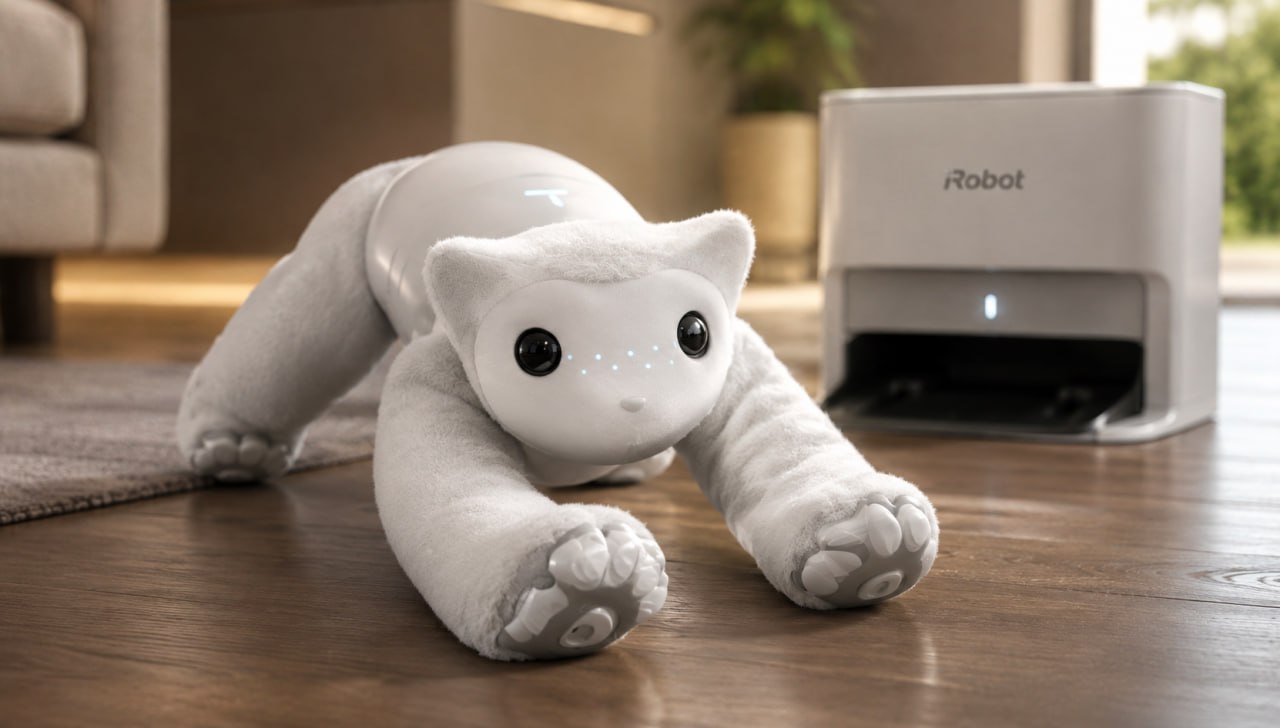
I have to admit, when I first read this Mashable article about Colin Angle’s new companion robot, I felt two things almost immediately: real technical curiosity and genuine parental hesitation.
That combination is probably the most honest place to start.
Angle is not some random founder chasing the latest AI headline. He helped bring Roomba into millions of homes, which means he already understands something many robotics companies do not: household technology succeeds or fails on trust, not just novelty. If a robot is going to live around families, it has to be predictable enough to feel safe, useful enough to justify its space, and intuitive enough that normal people don’t need an engineering degree to live with it.
That is why this new product from Familiar Machines & Magic is so interesting. It is not being pitched as another practical robot helper. It is not folding laundry, unpacking the dishwasher, or carrying groceries upstairs. It is being positioned as something more emotional than functional — more pet than appliance, more presence than tool.
And that is exactly what makes it fascinating and unsettling at the same time.
Most consumer robots so far have lived in one of two buckets. The first is the narrow utility machine: robot vacuums, lawn mowers, pool cleaners. They do one thing reasonably well and, if they are good, we stop thinking about them. The second bucket is the flashy demo robot that looks impressive in a video but rarely becomes part of normal life.
Familiar seems to be trying for a third category: a robot designed to build emotional connection.
That is not a small change. It is a different philosophy altogether. The company is talking about on-device AI, social awareness, touch sensitivity, body language, memory, and a non-verbal style of interaction that is meant to feel warm rather than robotic. If you watch the product in motion in this YouTube video, you can see why people are going to be drawn to it. It does not look like a machine trying to act smart. It looks like a machine trying to feel familiar.
From a product design perspective, that is brilliant. From a father’s perspective, it raises a much more serious question: what exactly are we inviting into family life when the machine is designed not just to assist us, but to emotionally attach to us?
I run a tech business, so I cannot look at something like this only through the lens of hype or fear. I look at what problem the company thinks it is solving and what kind of technical choices support that claim.
On that front, there is a lot to respect.
First, the privacy angle matters. If the company is serious about keeping most of the intelligence on-device rather than shipping everything to the cloud, that is the right instinct. In-home devices should earn trust by default, not demand it after the fact. A product that uses cameras, microphones, and behavioural memory in a household full of children has to be designed with restraint. “Trust us” is not enough. Local processing, clear controls, and limited data exposure are much stronger foundations than the typical modern app playbook of collect now and explain later.
Second, the non-verbal design choice is clever. A robot that constantly speaks can become exhausting. A robot that expresses itself through movement, sound, posture, and timing may actually fit more naturally into home life. In some ways, that is more emotionally intelligent than building another talking assistant that inserts itself into every room. The fact that Familiar appears to rely on body language instead of endless chatter makes it feel less like a screen with legs and more like a deliberately designed presence.
Third, I think the company has correctly identified a gap in the market. We have spent years building software that talks to us, listens to us, and predicts what we want. But almost all of it remains trapped behind a screen. Physical presence changes the equation. People respond differently to something that shares space with them, looks back at them, and reacts in real time. That has enormous potential in elder care, emotional support, routine-building, and child engagement.
So no, I do not think this is a silly idea. I think it is a very serious idea. That is why I am cautious.
If I brought a robot like this home, I have little doubt children would love it.
That is not the test.
Kids are wired to form attachments. They name stuffed toys. They talk to pets. They build emotional bonds with cartoon characters, game avatars, and voice assistants. If a robot can respond to touch, follow them around, tilt its head, react to their mood, and become a consistent presence in the home, then of course children will connect with it.
My concern is whether that connection would be healthy, bounded, and understandable.
Adults can at least attempt to hold two ideas at once: this thing feels emotionally responsive, and this thing is also a manufactured system designed to produce that response. Children, especially younger ones, are not great at drawing that line. They do not naturally distinguish between authentic reciprocity and programmed behaviour. To them, if it comforts, reacts, remembers, and seems to care, then it may simply feel alive.
That matters more than many people realise.
When a company builds a robot whose purpose is emotional engagement, it is not just designing hardware. It is designing patterns of attachment. It is shaping where affection goes, how attention is held, and what kind of feedback loop the child experiences. That is powerful territory. We should treat it with the same seriousness we would bring to any product that mediates children’s behaviour or development.
My biggest concern is not some sci-fi fear that a robot pet will take over the house. It is something much quieter: that children could become comfortable with a version of companionship that is endlessly responsive, emotionally flattering, and frictionless.
Real relationships are not like that.
Parents are busy. Siblings are annoying. Friends are inconsistent. Real pets need feeding, patience, care, and cleanup. All of that friction is part of development. It teaches empathy, resilience, negotiation, self-control, and the ability to deal with needs outside your own.
A companion robot may simulate some of the warmth without requiring the same kind of responsibility. It may offer comfort without inconvenience, attention without boundaries, and engagement without the unpredictability that normally comes with living beings. That could be appealing in the short term while quietly teaching the wrong lesson in the long term.
I would not want my kids absorbing the idea that the best companion is one that is always available, always responsive, and subtly engineered around their emotional preferences. That does not prepare them for people. It prepares them for systems optimised to keep them attached.
And that is where the technical side of me becomes even more alert. Any adaptive AI product is, by nature, learning what gets a reaction. It learns what calms, what delights, what sustains interaction, what draws attention back. In a commercial setting, that can drift toward optimisation goals that are not always aligned with healthy family life. Even if this company has good intentions — and it may well have them — the product category itself deserves scepticism.
Technology often enters the home by solving a visible problem while creating a less visible one. Smartphones made life more efficient and family attention more fragmented. Streaming made entertainment more accessible and shared viewing more optional. Social media made communication instant and presence thinner.
A companion robot could follow a similar pattern.
On paper, it might promote screen-free play, support routines, and provide comfort. In practice, I would want to watch whether it changes who children turn to first. Do they bring boredom to a parent, a sibling, a book, the backyard — or to the robot? Do they process frustration with people, or outsource soothing to the machine? Does it create imaginative play, or narrow it into interacting with a branded system that is always nudging the experience in a designed direction?
Those are not anti-technology questions. They are simply the questions a parent should ask before normalising emotionally intelligent machines in the middle of childhood.
Yes, absolutely.
I can imagine legitimate use cases where a robot like this is helpful rather than problematic. Some children respond well to routine, non-judgmental interaction, and a physical companion might help in ways a screen cannot. Some households cannot have a live pet because of allergies, rental restrictions, travel, or lifestyle constraints. Some older adults may benefit from a responsive presence that encourages movement, reduces loneliness, or creates a small sense of structure during the day.
I do not think the answer is to reject the entire category out of hand. That would be lazy. The better answer is to ask harder questions before embracing it.
How transparent is the system about what it stores and remembers? How much control do parents have over interaction patterns? Can the robot be meaningfully limited, scheduled, muted, or reset? Does the business model depend on subscriptions, upgrades, or cloud features that gradually expand its role in the household? And perhaps most importantly, does the company understand that products aimed at emotional attachment — especially around children — should be held to a much higher standard than products aimed at convenience?
As a technologist, I think Familiar is one of the more compelling consumer robotics ideas I have seen in a while. It is aiming at a real frontier instead of pretending another chatbot in a plastic shell is innovation. The team clearly understands that if AI is going to live in our homes, it has to feel socially legible, not just computationally capable.
As a father, though, I am not ready to wave it through.
I can admire the product vision and still say that my instinct is to be careful. Children do not need every technically possible form of companionship just because the market can build it. Some inventions deserve a slower, more sceptical welcome into family life.
Maybe this kind of robot will eventually earn that trust. Maybe it will prove useful, safe, bounded, and genuinely supportive. But for now, I think the right posture is interest without surrender. Watch it. Learn from it. Respect the engineering. And be very deliberate before you let an emotionally intelligent machine start shaping the emotional atmosphere of your home.
Ready to explore how emerging technology fits into real family life and business decisions? Get in touch with us to talk through AI, privacy, and practical adoption with a clear-eyed strategy.