A lot of small businesses do not feel busy in a neat, organised way. They feel busy in fragments. The phone rings while someone is in the middle of a job. A new enquiry lands while a customer is already waiting. A voicemail gets left at the wrong time. Someone says they will follow up later, and later turns into tomorrow.
Nothing about that sounds dramatic on paper. That is part of the problem. It does not look like one major failure. It looks like ten small interruptions, each one easy to excuse on its own, but together they create a business that always feels slightly behind itself.
Most owners know the pattern. The business is working. Customers are still coming in. Staff are still getting through the day. But the edges are messy. Calls get missed. Details get scribbled down and need to be decoded later. Follow-up becomes dependent on memory, good intentions, and whether the day leaves enough room to catch up.
That is usually where interest in AI phone receptionists and AI personal assistants starts. Not from some abstract fascination with AI itself, but from a more ordinary frustration: too much time is being lost to repetitive admin, scattered communication, and constant interruption.
People often talk about these tools as if they are basically the same thing. They are not. They live in the same neighbourhood, but they do different jobs. One is about handling incoming communication at the front of the business. The other is about helping the business do something useful with that communication once it arrives.
That distinction matters more than it sounds. When businesses skip past it, they tend to either expect too much from one tool or end up with another layer of software that makes the workflow look modern without actually making it cleaner.
Picture a normal day in a service business. It could be a clinic, a consultancy, a trade business, an agency, a law office, a property service, an accounting firm. The exact setting does not matter much, because the rhythm is familiar across all of them.
The day starts with a clear plan. There are jobs to do, clients to see, projects to move along. Then the first call comes in. If someone answers, they are pulled out of what they were doing. If they do not answer, the caller may leave a message, or they may just move on. If they do answer, the conversation still has to be turned into something practical. Someone has to note the details, work out whether it is urgent, figure out who should take it, maybe send a document, maybe book a time, maybe check whether there was already a previous conversation.
Then the next call comes. Then an email. Then a calendar change. Then an internal question about the first enquiry.
For a lot of small businesses, the problem is not lack of effort. It is that the work arrives in pieces. The team is constantly stepping out of one context and into another. That kind of context switching drains time and attention more than most people realise. At the end of the day, everyone feels busy, but not always confident that the right things got proper follow-up.
This is where the difference between an AI phone receptionist and an AI personal assistant becomes useful in a practical sense rather than a marketing sense.
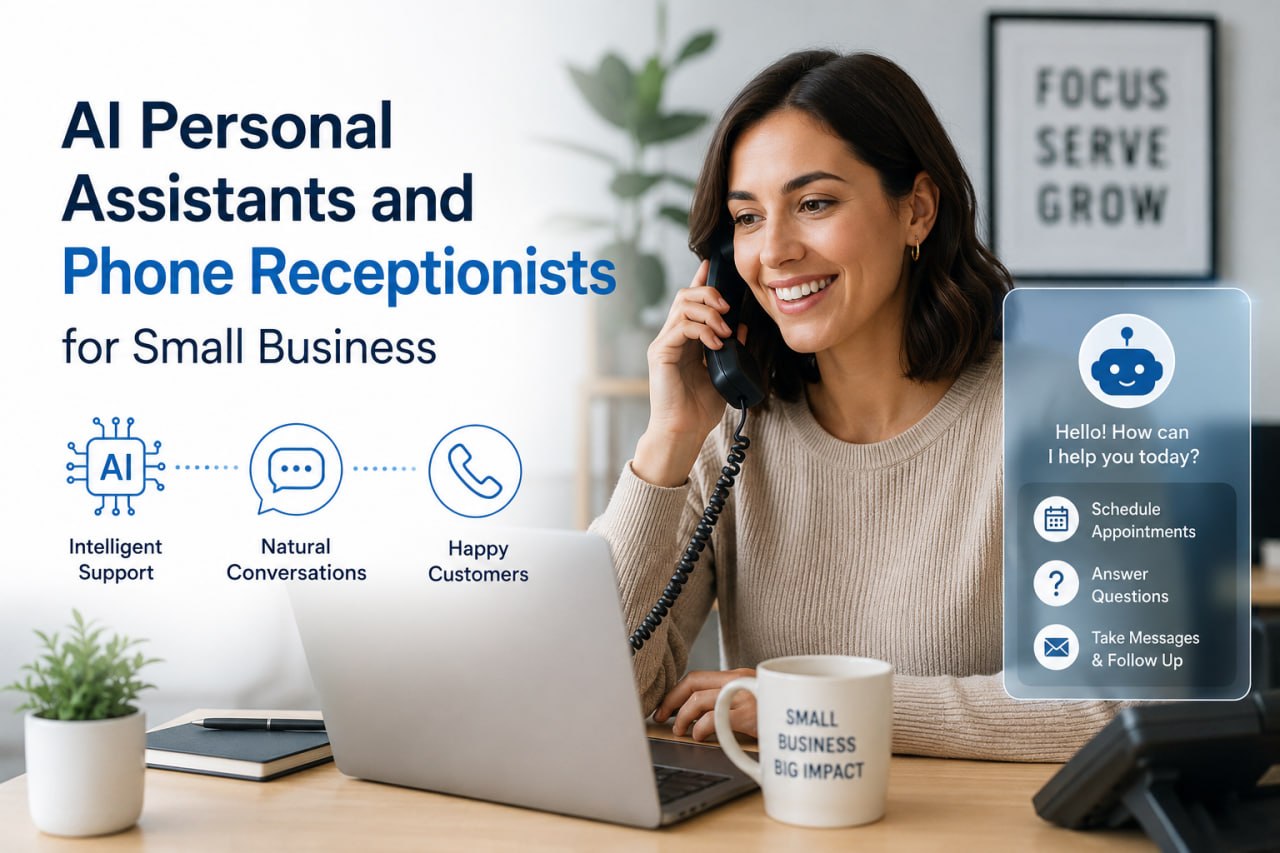
The phone receptionist sits at the front door. Its job is to answer, greet, capture, route, and respond to the predictable part of incoming communication. It helps when nobody is free, when calls come after hours, when the same basic questions keep coming up, or when the business simply needs more consistent first contact than a rushed team can give every single time.
The personal assistant works further inside the business. It helps with what happens after the interaction. It can summarise the call, prepare the next step, draft a reply, log notes, create a task, prompt follow-up, update a system, or help someone quickly understand the context without hunting through half a dozen messages.
One deals with the interruption. The other deals with the aftermath.
That is why bundling them together into one vague category usually misses the real point. A business that struggles with missed calls has one kind of friction. A business that answers calls but never follows through cleanly has another. Many businesses have both.
The reason these tools matter is not that they make a business sound futuristic. The real benefit is quieter. The day stops splintering so easily.
Instead of every phone call becoming a fresh interruption that someone has to manually absorb, part of the process is handled more consistently. Instead of details sitting in someone’s head until they have a spare moment, the information can move into a clearer next step. Instead of follow-up depending on whether the day becomes less chaotic, there is a better chance the business keeps moving while the team stays focused on the work only humans should be doing.
That relief shows up in small ways first. Fewer calls disappear. Fewer leads cool off while waiting for a response. Fewer staff members waste time asking each other what happened with a particular enquiry. Fewer handwritten notes end up becoming a second puzzle later in the day.
But over time those small gains add up. The business starts to feel less reactive. Not perfect, not fully automated, just less jagged. There are fewer moments where a customer experience depends entirely on whether the right person happened to be free at the right second.
This is why the strongest use case is usually not a business picking one tool in isolation and hoping for a miracle. It is creating a clearer path from first contact to next action.
A caller rings. The receptionist answers, captures the reason for the call, works out whether it is a booking, a quote request, a support issue, a simple question, or something that needs a human straight away. The assistant then helps carry that information forward. It turns the conversation into a summary, a task, a booking note, or a draft reply that somebody can act on without starting from scratch.
That is a much more grounded improvement than simply saying a business has “AI”. It means front-of-house and back-office work are connected more cleanly. It means the staff member who picks up the thread later is not forced to reconstruct the situation from memory or scraps. It means the business is less likely to lose energy in the handover between communication and action.
For consultants, clinics, agencies, trades, and other businesses where trust, responsiveness, and timing matter, that can make a real difference. People do not only judge a business on the quality of its service. They also judge it on how easy it is to reach, how quickly it responds, and whether it seems organised from the first interaction onward.
In that sense, the value is not only operational. It is reputational as well.
The question is not really whether a business “needs AI”. That question is too broad to be useful. Almost every conversation about technology gets worse once it becomes that abstract.
A better question is whether the business keeps leaking time and attention through the same points of friction. Are calls being missed because everyone is already busy? Are enquiries being captured but not followed through properly? Are staff constantly switching context to answer simple questions or chase basic details? Is too much of the process living in people’s heads rather than in a workflow that can support them?
If the answer is yes, then this is not really a conversation about AI for its own sake. It is a conversation about better flow.
That is the useful frame for AI phone receptionists and AI personal assistants in small business. One helps the business respond at the front. The other helps the business stay organised behind the scenes. Together, they reduce drag around the ordinary work that keeps piling up day after day.
Used well, they do not replace judgment, relationships, or the human side of running a business. They remove friction around those things. They give the team a better chance to stay present in the work that matters, instead of constantly being pulled sideways by admin and communication overhead.
For a lot of small businesses, that is the real win. Not some dramatic transformation story. Just a business that feels less scattered, follows up more reliably, and handles growth without every extra enquiry turning into more internal strain.
Ready to improve how your business handles calls, follow-up, and day-to-day admin? Get in touch with us to explore a setup that fits the way your team actually works.