For a long time, the website decision was framed in fairly simple terms. If a business wanted something fast and cheap, a website builder was usually the answer. If it needed a bit more flexibility and content control, WordPress often sat in the middle. If it needed something unique or deeply integrated, custom development was the premium path, with the usual assumption that it would take longer and cost more.
That model is starting to shift.
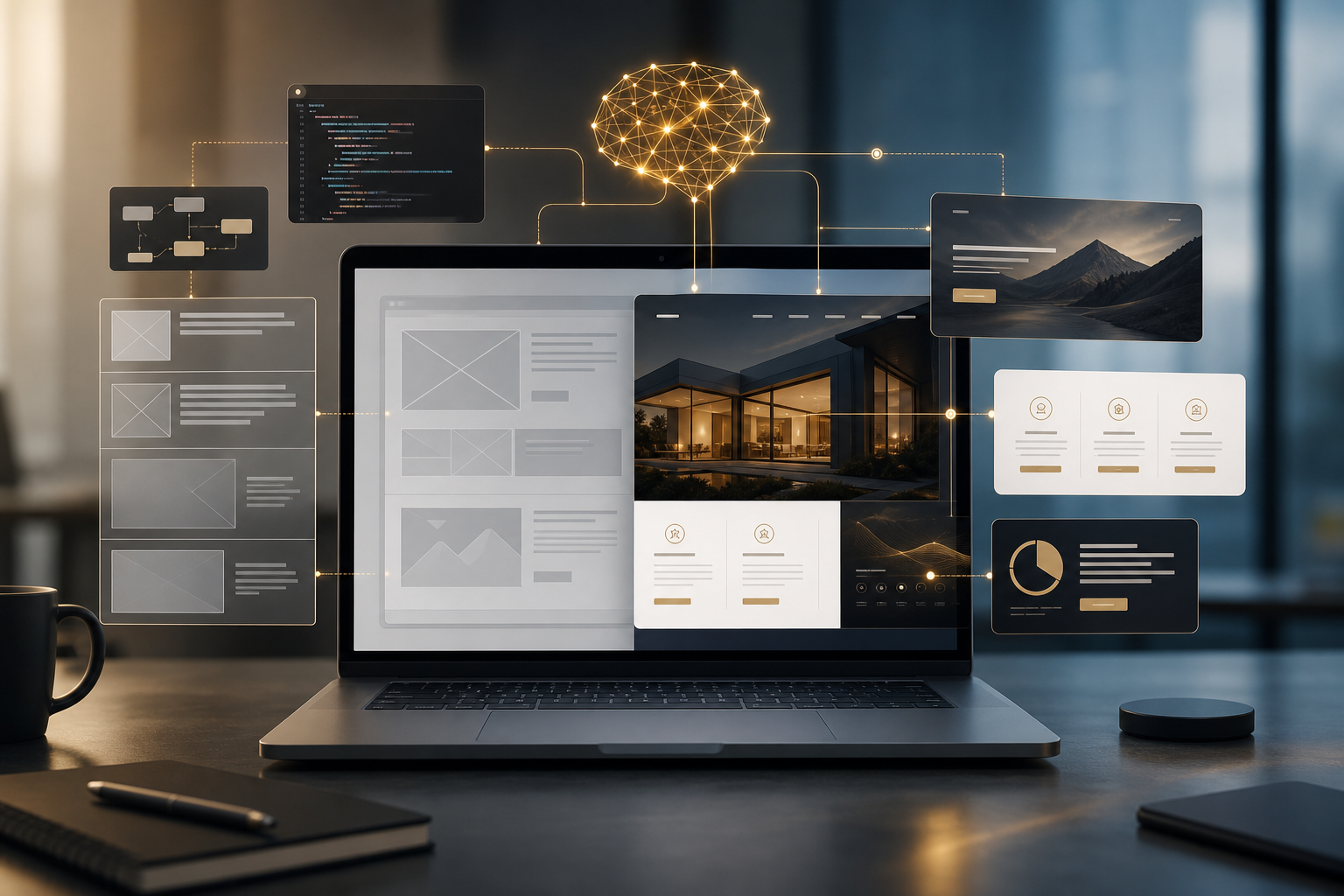
Artificial intelligence is not eliminating the need for developers, designers, strategists, or technical oversight. But it is changing how web projects get delivered. AI agents can now help with scaffolding, interface implementation, code generation, testing, debugging, content structuring, documentation, and repetitive integration work. That does not make custom development effortless, but it does compress parts of the delivery cycle that used to be slower and more expensive.
The result is that businesses should revisit some old assumptions. Custom web development is no longer as automatically out of reach as it once seemed. At the same time, website builders and WordPress still have strong use cases, especially when simplicity matters more than flexibility.
The smarter question in 2026 is not which platform is universally best. It is which option makes the most sense given your business goals, your operational complexity, and how much AI is changing what you can realistically build.
Historically, the website stack decision involved a familiar set of trade-offs.
Website builders won on convenience. You could launch quickly, control costs, and avoid a heavy development process. For small businesses, local service providers, consultants, or simple brochure sites, that was often enough.
WordPress offered more room to move. It gave businesses stronger content management, a large plugin ecosystem, better extensibility, and a broader pool of developers. For marketing sites, blogs, content-heavy businesses, and medium-complexity projects, it became the default middle ground.
Custom development offered the most control, but it came with a reputation for being slower, riskier, and more expensive. That reputation was not entirely wrong. Building from scratch requires architecture decisions, frontend implementation, backend logic, testing discipline, hosting choices, deployment processes, and long-term maintenance. A business had to genuinely need that flexibility to justify the extra investment.
That older logic still matters, but AI is now reducing some of the friction that used to push businesses away from custom work too early.
A lot of AI discussion is vague, inflated, or detached from delivery reality. The practical effect on web development is more specific.
AI agents are useful where work is repetitive, pattern-based, or constrained enough to accelerate a skilled team rather than replace it. In web projects, that includes generating starting points for interfaces, building repeated page sections, translating design intent into code, drafting data models, writing boilerplate logic, suggesting tests, tracing common bugs, and helping developers move through implementation faster.
That matters because much of the cost in custom development has never come from one dramatic technical challenge. It comes from the accumulation of smaller tasks. A landing page here. A form flow there. API wiring. CMS structures. Validation rules. Refactoring. Responsive layout fixes. Edge-case handling. AI can reduce the time spent on some of those layers, especially when an experienced developer is directing the process and cleaning up the output.
In plain terms, AI does not magically build a great business website on its own. What it does is narrow the gap between “template-based fast” and “custom but too expensive.” That gap used to be wider.
This does not mean website builders suddenly became obsolete. They are still the right answer in a lot of situations.
If a business needs a simple online presence, a small number of pages, standard lead capture, and minimal integration, a builder can still be the most rational choice. Restaurants, trades, local service businesses, solo operators, and early-stage concepts often do not need a fully custom stack. They need a website that is presentable, easy to update, mobile-friendly, and quick to launch.
Builders are also useful when the main priority is reducing coordination overhead. They provide hosting, templating, visual editing, and a controlled environment. For some teams, that predictability matters more than deep flexibility.
AI does improve the output of builders as well. It can help users generate page copy, draft layouts, create imagery, and fill in basic marketing content faster. But this is where the limits start to show. AI may help you fill a builder more quickly, but it does not change the underlying constraints of the platform itself.
If your business website is mainly informational, that may not be a problem. If the website needs to behave more like a tailored system, it often becomes one.
Website builders were historically protected by one major advantage. Even if they were limiting, they were much faster and cheaper than going custom. AI weakens that advantage.
Once a business needs custom workflows, better-performing landing pages, deeper CRM integration, more structured SEO control, or a more distinctive user journey, the builder environment starts feeling tight. The old response would be to tolerate those limitations because leaving the platform was too costly. That calculation is becoming less obvious.
If AI lets a delivery team prototype and iterate a custom solution faster than before, then the premium for going custom may no longer be as large as it used to be. That does not mean custom will always win, but it does mean businesses should stop assuming a builder is automatically the economical choice just because it is familiar.
The danger is that a business launches fast on a builder, then spends the next two years working around the platform instead of working through it. That can be acceptable for simple sites. It becomes expensive when the site starts to matter operationally.
WordPress remains useful because it solves a different problem. It is not just a template system. It is a mature content management ecosystem with a huge plugin market, strong editorial capabilities, and broad developer familiarity. For many businesses, that still makes it a sensible middle path.
Content-heavy websites, marketing-led businesses, publishers, service firms, and teams that need frequent page updates often benefit from WordPress. It gives more control than a builder without forcing every project into a ground-up engineering exercise. When used carefully, it can be flexible enough for a large share of business websites.
It also remains a reasonable option for businesses exploring light automation, SEO-driven content strategies, and standard integrations. In many cases, WordPress is good enough, and good enough is a perfectly valid outcome.
That said, AI is changing the comparison here too. If AI accelerates custom component building, custom CMS workflows, and repeated implementation work, some projects that would previously default to WordPress may now justify a more tailored build earlier in the process.
The cost problem with WordPress is usually not the initial build. It appears later.
Plugin sprawl, update friction, security maintenance, performance drag, and awkward customisations can slowly turn a manageable website into a fragile one. Many WordPress sites accumulate technical debt in a quiet, incremental way. A plugin solves one need. Another handles forms. Another handles caching. Another handles SEO. Another handles memberships or events or page layouts. Each one seems reasonable in isolation. Over time, the site becomes harder to reason about.
AI does not remove that structural problem. In fact, it can expose it more clearly. If a business wants faster iteration, cleaner automation, or more control over tailored experiences, a crowded plugin architecture may become the bottleneck rather than the solution.
This is why the platform decision should not be framed as “can WordPress do it at all.” In many cases it can. The real question is whether it can do it cleanly, maintainably, and with enough room for the business to evolve without accumulating avoidable overhead.
This is where the biggest shift is happening.
Custom development used to be ruled out quickly for many small and medium-sized businesses because the economics looked too heavy. Design, frontend, backend, infrastructure, content structures, integrations, testing, and revision cycles stacked up quickly.
That cost pressure has not vanished, but AI is changing the slope. Skilled teams can now move faster on scaffolding, iteration, troubleshooting, and implementation support. That makes it easier to build bespoke websites, customer portals, marketing flows, dashboards, configurators, and integrated web applications without absorbing quite as much delivery drag as before.
This matters most when the website is not just a digital brochure. Once the website becomes tied to quoting, onboarding, customer data, booking logic, internal workflows, product configuration, search, automation, or operational systems, the value of custom control rises. In those cases, the ability to ship tailored experiences more efficiently changes the financial conversation.
A business that once assumed custom work was only for enterprise budgets may now find that the gap between a patched-together platform stack and a purpose-built solution is narrower than expected.
That is one reason many businesses exploring web development are rethinking their options. The platform decision is becoming less about category labels and more about how much the website actually needs to do.
This is the part that gets skipped too often in AI-heavy web development discussions.
AI can accelerate implementation, but it does not remove the need for judgment. It does not understand your business model by default. It does not automatically make strong architecture decisions. It does not guarantee security, long-term maintainability, good UX, or sensible technical boundaries. It also does not protect a business from poor requirements, weak content, confused messaging, or bad product strategy.
If anything, AI makes technical leadership more important, not less. Faster production means mistakes can also be produced faster if the project lacks direction. Businesses still need someone who can decide what should be built, how the system should be structured, where customisation is worth it, what should remain simple, and how to avoid creating a more expensive mess at higher speed.
That is why custom work accelerated by AI is not the same thing as uncontrolled AI-generated development. The value comes from combining speed with discipline.
In practical terms, the right choice depends on how central the website is to the business.
If the website mainly needs to inform, reassure, and collect basic enquiries, a builder may still be enough.
If the website is content-driven, needs editorial flexibility, and can tolerate some ecosystem complexity, WordPress may still be the most efficient middle ground.
If the website is becoming part of the operational engine of the business, custom development deserves more serious consideration than it did a few years ago. AI has not made it free, but it has made it more accessible.
That is especially true for businesses also thinking about workflow automation, personalised user journeys, or deeper integrations with internal systems. Once a business wants the website to connect intelligently to how it actually operates, the limitations of generic platforms become more visible.
It is also worth thinking beyond launch day. The cheapest option upfront is not always the cheapest option over two years. A platform that saves money at the start but creates friction every time the business grows, changes, integrates, or experiments can become the more expensive choice in practice.
Businesses often frame this as a binary question. Should we go custom or should we stay on a platform?
That is too blunt. The better question is how much uniqueness, control, and integration your website genuinely needs, and whether AI has changed the cost of achieving that in your case.
Some websites still should not be custom. Others should have been custom much earlier but were pushed into tools that no longer fit. The point of AI is not that it makes every business website bespoke. The point is that it gives more businesses the option of building something better suited to their needs without the same delivery penalty that once made custom feel unrealistic.
That is a meaningful shift in web development economics.
If you already know your website is central to lead generation, customer experience, internal process, or system integration, it may be time to look beyond templates and ask what a more tailored build would actually cost now. In many cases, the answer is changing.
If you are weighing up a builder, WordPress, or a more tailored solution, it helps to look at the decision through both a technology and business lens. If your website is starting to behave more like a business system than a brochure, it may be time to take a closer look at what tailored web development now makes possible. Get in touch with us to work through the right path for your business.