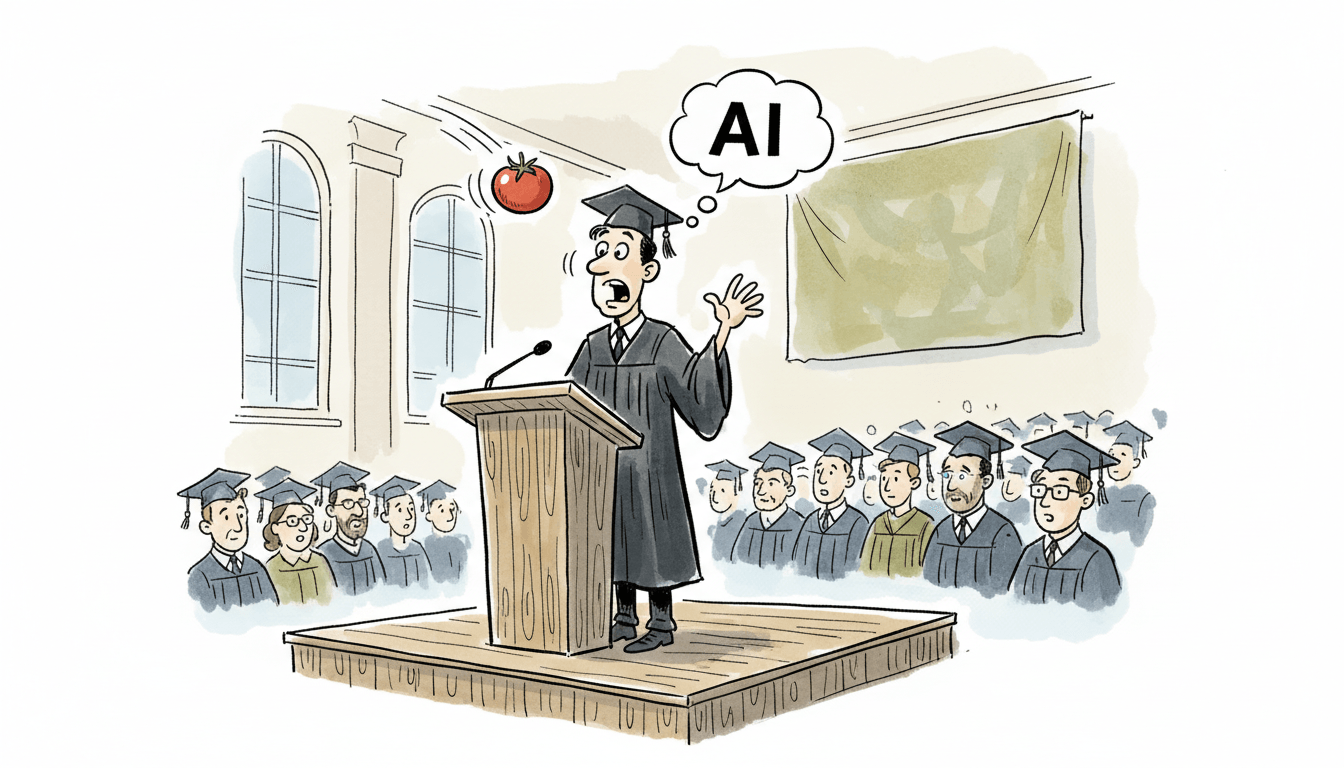
On May 8, 2026, a real estate executive named Gloria Caulfield stood in front of thousands of arts and humanities graduates at the University of Central Florida and told them that artificial intelligence is "the next industrial revolution."
The crowd booed her, loudly. One graduate shouted "AI sucks!" from the audience. Caulfield, visibly stunned, stepped back from the podium and asked, "What happened?" When she tried to recover by saying "only a few years ago, AI was not a factor in our lives," the same crowd that had booed her erupted into cheers.
Two days later, on May 10, Jensen Huang, the CEO of NVIDIA, delivered the commencement keynote at Carnegie Mellon University. He talked about the same technology. He told graduates they were entering the workforce "at the beginning of the AI revolution" and to "run, don't walk" toward it. The Carnegie Mellon crowd cheered him.
Two ceremonies. Two days apart. Same topic. Opposite reactions.
This is not a one-off. Earlier this year, former Google CEO Eric Schmidt was booed at his own commencement speech when he told students they would "help shape artificial intelligence." Across the 2026 graduation season, a pattern has emerged: AI is no longer a neutral applause line. For a growing portion of the public, it has become a flashpoint. If you run a business and you are thinking about adopting AI, this matters more than you might think.
It is tempting to dismiss the booing students as anti-technology Luddites who do not understand what is coming. That reading is wrong, and if you adopt it as a business owner here in Australia, you will make expensive mistakes.
The students at UCF were not booing artificial intelligence in the abstract. They were booing a real estate executive who had just told a room full of writers, journalists, designers, and communicators that the technology displacing their industry is actually a wonderful opportunity for them. They were booing the framing, not the technology.
The numbers back the students' frustration up. In the United States, Anthropic CEO Dario Amodei has publicly predicted that AI could eliminate up to fifty percent of entry-level white-collar jobs. But you do not have to look overseas to find the same pattern. Here in Australia, graduate job opportunities fell 14.7 percent in 2025, the third consecutive annual decline, with AI-exposed occupations falling harder than the rest. Tech layoffs have accelerated sharply in 2026, with Australia now ranking second globally for tech job losses and Sydney sitting third in the world for absolute numbers cut, behind only San Francisco and Seattle. Industry reporting attributes AI as the primary driver behind essentially every Australian tech sacking this year.
And the public has noticed. The 2025 KPMG and University of Melbourne global trust survey, which covered 47 countries and nearly 50,000 respondents, found that only 36 percent of Australians are willing to trust AI. Seventy-eight percent worry about negative outcomes from it. And only 30 percent believe AI's benefits outweigh its risks. That is the lowest share of any country surveyed. Not in the bottom ten. The lowest. Full stop.
The software engineer Cabel Sasser summed up the dynamic perfectly after the UCF video went viral. "When you're inside the bubble," he said, "you think everybody else is. But everybody isn't." If you are an Australian business owner reading the tech press every day and getting excited about AI, you should know that you are reading a small bubble of voices. The 70 percent of Australians who do not trust AI yet are your customers, your staff, and your community.
Look closely at the Caulfield and Huang ceremonies side by side. They are talking about the same technology. The students are not reacting to artificial intelligence. They are reacting to how it is being sold to them.
Caulfield framed AI as a force, an industrial revolution that was happening to the graduates. Huang framed it as a tool that the graduates themselves would use to do work that mattered. He also said something Caulfield did not. "AI is not likely to replace you," Huang told the Carnegie Mellon crowd, "but someone who knows how to use AI might replace someone who does not."
That single sentence is the entire difference between the two reactions. One framing strips agency away from the audience. The other gives it to them. The students at UCF were not rejecting AI. They were rejecting the idea that their futures had already been decided by people in suits.
Here is what years of actually building AI-powered systems for businesses has taught me. AI does not replace expertise. It amplifies it. And if there is no expertise to amplify, AI does not help. It just produces confident nonsense faster than a human could.
A junior staff member who does not understand accounts payable cannot use AI to do accounts payable. They cannot tell when the model is wrong. They cannot spot the edge case the prompt missed. They cannot push back on a hallucinated invoice number. A senior staff member who has done accounts payable for ten years, on the other hand, can now do the same work in a quarter of the time. The AI handles the rote pattern matching. The human handles the judgement.
This is why the rush to cut entry-level roles is so short-sighted. Companies replacing juniors with AI are eating their own talent pipeline. In five years they will have no seniors, because nobody got the years of grinding through small problems that build judgement in the first place.
Most failed AI implementations in small and medium businesses are not actually AI failures. They are workflow failures.
A business owner reads a headline about AI agents and decides to plug one into their operations. There is no documented process for the work they are trying to automate. There is no clear definition of what a good output looks like. There is no measurement in place to tell whether the AI is actually doing the job better than the person it replaced. Six months later they are paying for an API, getting worse results than before, and blaming the technology.
The technology was not the problem. The problem was that you cannot automate a process you have not first understood. AI is a force multiplier. If you multiply chaos by ten, you get more chaos faster.
The businesses that get real value out of AI are not the ones with the biggest budgets or the newest models. They are the ones who can answer three questions clearly. What is the workflow. Who currently does it and why. What does a good outcome look like. If you cannot answer those three questions, no AI tool on the market will save you. If you can answer them, even a modest AI implementation will pay for itself within months.
The right question for a small business considering AI is not "what role can I eliminate." It is "what is my best person spending too much time on."
Those are different questions with very different outcomes. The first one produces redundancies, brittle systems, and a team that resents the technology you brought in. The second one produces faster turnaround, less burnout, and a team that has more time to do the work only humans can do. That is also the version of AI adoption that does not get booed.
In practical terms, the highest-leverage uses I have seen for small and medium businesses are unglamorous. Workflow automation that takes a five-step manual process and reduces it to one click. Document processing that pulls structured data out of PDFs and emails so humans do not have to retype it. Customer support triage that routes the easy questions to the right place so your team can focus on the hard ones. API integrations that make systems talk to each other without someone copying numbers between two screens. None of this is glamorous. None of it would make a good commencement speech. All of it makes the business measurably better.
Here is the practical takeaway for any business owner reading this. The way you talk about AI inside your own business matters as much as the technology itself.
If you walk into a Monday meeting and tell your team that AI is the next industrial revolution and everyone needs to "adapt or be left behind," you have just done a small version of what Caulfield did at UCF. Your staff will hear it the same way the graduates did. As a threat. As a hint that their jobs are on the chopping block. The good ones will start updating their CVs that afternoon.
If instead you walk in and say "we have a problem with how long it takes to process supplier invoices and I want to see if we can use AI to fix it, with you in charge of making sure the output is right," you have done the Huang version. You have given your team a tool, not a threat. You have kept the human in the loop where the judgement lives. You have made AI adoption a project people want to work on, not one they dread.
The companies that will win the next five years are not the ones cosplaying as the next industrial revolution. They are the ones quietly building AI into the workflows they already understand, in service of the people who already work for them.
The UCF students were not wrong to boo. They were rejecting a story being told about their future by someone who had clearly not thought about how it lands on the other side of the stage. That same story, told at scale, is why only 30 percent of Australians currently believe AI's benefits outweigh its risks. The technology has been so badly sold that a lot of people are now reflexively against it, even when it would help them.
As a business owner you have a chance to tell a different story. A quieter one. AI is a tool. Your people are the experts. The workflows come first. The technology comes second. If you do not understand the work, no model on the market can help you. If you do, the right tool can make a small team punch well above its weight. That is the version of AI adoption nobody boos. That is also the version that actually works.
That quieter version is most of what we do — workflow automation, document processing, API integrations, and honest advice about where AI fits and where it doesn't. If that sounds useful, have a look at our AI consulting service.