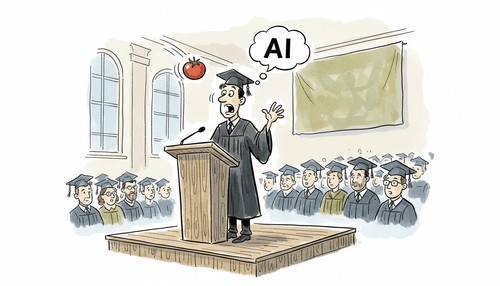
In January 2026, KPMG Australia released the eighth edition of its Keeping us up at Night survey. It is a quiet annual document. Most years it lands, gets a few write-ups, and disappears. This year is different. For the first time in the survey's history, AI is the single biggest worry facing Australian business leaders, not just for the year ahead, but for the next three to five years as well.
Sixty-three percent of the 274 C-suite executives and board members surveyed named new technologies including AI as their number one concern for 2026. Sixty-one percent said the same about the medium term. Fifty-nine percent flagged the social impact of these technologies as their top social concern, ranking it above housing affordability. That last comparison is worth sitting with for a moment. Housing affordability is the issue that has dominated Australian political conversation for years. AI just overtook it inside the boardrooms of the country.
The jump is the part that should make you pay attention. In KPMG's 2025 survey, new technologies including AI sat in fourth place at 39 percent, behind digital transformation, cyber risks, and inflation-driven cost controls. Twelve months later it has climbed to first place at 63 percent. That is not a gradual shift. That is the corporate equivalent of waking up in the middle of the night.
What changed. The technology itself did not suddenly become more capable in January. The models that Australian executives are losing sleep over were largely available the year before. What changed is that the gap between what the technology can do and what most Australian businesses are doing with it has become impossible to ignore.
The KPMG report is fairly explicit about what is driving the anxiety. Leaders are worried about use cases and the ethical issues surrounding implementation. Translated out of survey language, that means two related things. They do not know which problems in their business AI should be pointed at. And they are nervous about getting the implementation wrong in a way that creates legal, reputational, or operational damage.
Here is the gap we see in practice. The boardroom anxiety in the KPMG numbers is genuine. The response to it, in most Australian businesses, is not.
The typical response goes something like this. A senior leader reads the headlines and asks the team to put together an AI strategy. Someone runs a workshop. A vendor pitches a chatbot. A consultant produces a slide deck with a maturity model on slide nine. Nine months later the business has spent six figures and produced a press release, a Microsoft Copilot rollout that half the staff have forgotten about, and exactly zero changes to how work actually gets done.
This is not because the leaders are stupid. It is because the question they were asked to answer is the wrong question. "What is our AI strategy" is a question that produces strategy documents. "What is taking our best people too long and why" is a question that produces actual change. The first question is what gets asked in the boardroom. The second is what needs to be asked on the floor.
Look at the rest of the top five in the KPMG survey. Digital transformation in second place. Cyber security in third. Regulatory processes in fourth. Productivity growth in fifth. These are not separate concerns from AI. They are the same concern wearing different hats.
Every AI rollout is a digital transformation project, whether anyone called it that or not. Every AI rollout creates new attack surface, because you are now sending business data to a model API and getting back outputs that downstream systems will act on. Every AI rollout creates new regulatory exposure, particularly in Australia where the Privacy Act reforms and the proposed AI guardrails for high-risk settings are still settling. And every AI rollout is being justified by productivity gains that are largely unmeasured because most businesses do not have baseline productivity data on the workflows they are trying to improve.
The reason cyber stays stubbornly in the top three is that the people responsible for security can already see what is coming. The pattern we see in most AI projects is that the security review happens after the procurement decision, not before. By then it is too late to redesign the integration, so security signs off on something they would not have approved if asked earlier.
If you are one of the executives in that 63 percent, here is what we think would actually help. Not a strategy document. A short, honest, ground-level audit of your business.
Start with three questions. Where in the business are senior people spending time on work that does not require their judgement. Which workflows have a clear input, a clear output, and a definition of "good" that anyone could agree on. Where do you have data that is currently being retyped, copied between systems, or summarised by hand. These three categories are where AI actually creates value in small and medium Australian businesses. They are unglamorous. They will not produce a press release. They will save you measurable hours per week within ninety days.
Then resist the urge to start with the biggest, hardest workflow. The worst possible first AI project is one that touches customer data, requires regulatory sign-off, and replaces a senior person. The best possible first AI project is one that automates an internal report nobody loves, with a human reviewing the output for the first month, and a clear measurement of how much time it saves. Boring projects build the judgement and the internal trust you need to attempt the bigger ones later.
The KPMG survey calls out ethics specifically. This is the part most consultants will skip over because it is uncomfortable, so we will not.
The ethical question every Australian business owner adopting AI needs to ask themselves is not abstract. It is this. If this AI tool works as advertised, what happens to the people whose work it replaces or compresses. Do you have a plan for them. Are you redeploying them to higher-value work, or are you using the productivity gain to cut headcount. Both are legitimate business choices. Pretending you have not made one is not.
The reason this matters is that your staff are also reading the same headlines as your customers. They know what AI can do. If you bring in an AI tool and pretend it is not going to change anyone's role, they will not believe you, and you will lose the trust you need to actually make the rollout work. If you tell them honestly that this tool will free them from rote work so they can focus on the harder problems, you give them a reason to help you succeed. If you tell them honestly that the business is automating a function and you are working with affected staff on what comes next, you give them a chance to plan. What you cannot do is say nothing and hope nobody notices.
One last thing worth saying. The KPMG survey is being reported as evidence that Australian executives are nervous about AI. That is true as far as it goes. But the more interesting read is that 63 percent of leaders just publicly acknowledged that this is their biggest problem. That is an enormous shift from twelve months ago, when most leaders would have said the right answer was "we are watching the space."
When a problem moves from "watching the space" to "the single biggest thing keeping me up at night," budget follows. The Australian businesses that work out how to spend that budget well over the next twelve months will have a meaningful edge over the ones that spend it on strategy decks and pilot projects that never reach production. The ones that do not work it out will burn through their AI budget the same way many businesses burned through their early cloud budget. Lots of activity, lots of invoices, very little operational change.
The honest version of AI consulting in 2026 is not about telling you AI will transform your business. You already believe that, or you would not be in the 63 percent. It is about doing the unglamorous work of identifying where it actually fits in yours, building it in carefully, measuring whether it worked, and being straight with your team about what changes. That is also the version that produces results you can point to a year from now instead of a strategy document gathering dust.
If that sounds more useful than another maturity model, that is most of what we do at Azar Consulting — workflow automation, document processing, API integration, and honest advice about where AI fits and where it doesn't. Have a look at our AI consulting service or the virtual CTO service if you want a senior technical perspective without the headcount.