Some software ideas start with market research, trend reports, or a polished product strategy deck. This one started with frustration.
I was trying to check on family flights to Lebanon through Aunt Betty, and every call felt like the same loop. I would ring up, wait on hold for close to two hours, finally get through to someone, get put on hold again, and then sometimes have the call drop anyway. After enough rounds of that, the problem stopped feeling like a small inconvenience and started feeling like something that clearly should not exist in 2026.
That experience became the reason I built OnHoldMate.
Anyone who has had to deal with airlines, travel agencies, banks, telcos, insurers, or government departments knows the pattern. You call because you need a real answer to a real problem. Then your time gets consumed by hold music, queue messages, call transfers, and dead ends.
The frustrating part is that holding on the line is not valuable work. It is just wasted attention. You cannot properly focus on anything else because you are half waiting for someone to finally pick up. And if you step away or lose concentration at the wrong moment, you miss the call and have to start again.
In my case, it was not hypothetical. I was trying to sort out something important for family travel, and the process was eating hours at a time for no good reason. That is usually when a software problem becomes worth solving. Not because it sounds impressive, but because the existing way of doing it is obviously broken.
Before building anything, I tried the normal path first. I assumed something like this must already exist. A service that waits on hold for you, keeps listening, and alerts you when a human actually comes on the line feels like an obvious enough idea.
There are some built in versions of this on certain devices. iPhone and Google Pixel users have had access to hold assist style features for a while. But I was on Samsung, and I could not find something that gave me the same practical outcome. What I needed was not a device-specific feature announcement. I needed something that worked for me, right then, on the phone I actually had.
Once I realised there was not a clear option available to me, the idea shifted. This was no longer just a feature I wanted someone else to ship. It was a product gap.
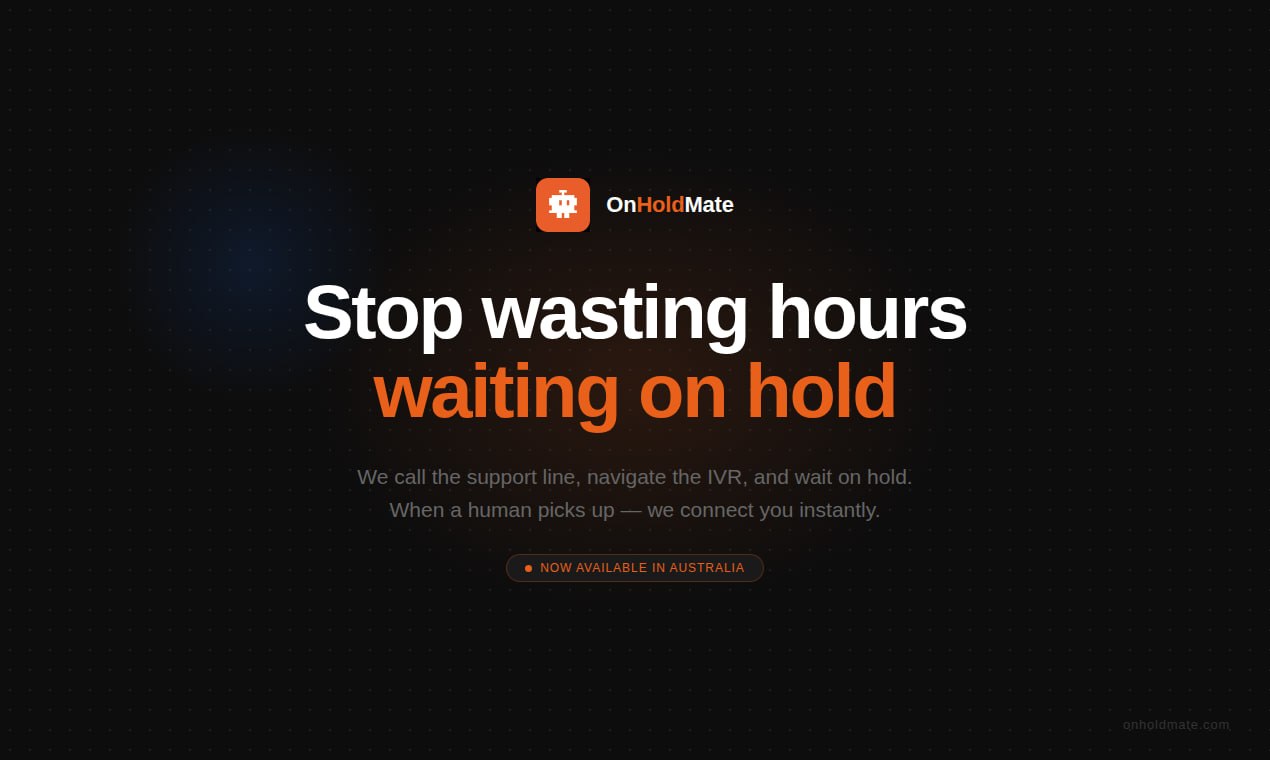
The core idea is intentionally simple. If a person needs to talk to a business but most of the interaction is just waiting through hold music and queue systems, software should be able to absorb the waiting and hand control back when it matters.
That sounds small, but it changes the shape of the experience. Instead of forcing someone to donate an hour or two of attention to a phone queue, the software does the boring part and lets the person get on with their day until a real conversation is possible.
That is the idea behind OnHoldMate. It is not trying to replace customer service, pretend to resolve complex issues automatically, or turn every phone call into a fully autonomous workflow. It is solving the most wasteful part of the experience: the dead time before anything useful happens.
In a lot of software, the best opportunities are not grand reinventions. They are the moments where a bad process has become so normal that people stop questioning it. Staying on hold for hours is one of those processes.
I could have treated this as a one off hack for my own use. Build something rough, use it for the calls I needed, and move on. But the more I thought about it, the more it felt like a broadly shared frustration rather than a personal edge case.
Most people have had some version of this experience. You are trying to speak to a real person because the situation actually matters, and the system makes you waste time proving you are willing to wait long enough. That is not a niche pain point. It shows up across travel, finance, utilities, healthcare, and plenty of other industries.
Once you see that clearly, launching it for other people starts to make sense. Even if the first trigger was a family travel issue, the underlying problem is universal enough that other people can benefit too.
There is a tendency in startup and product conversations to make ideas sound more strategic than they really are. In practice, a lot of worthwhile products begin with a very ordinary moment: something annoys you enough times that you stop accepting it as normal.
That was the case here. I was not trying to invent a new category because it looked exciting in a pitch deck. I was trying to stop wasting hours on hold. The product came later.
That matters because it influences how software gets built. When an idea comes from direct frustration, it usually stays closer to the real job the user needs done. The goal is not to accumulate features for the sake of it. The goal is to remove the most pointless part of the experience.
For OnHoldMate, that meant keeping the thinking grounded in a simple question: how do you give someone their time back when a phone queue is the only path to getting something resolved?
One of the more interesting things about modern software is that the threshold for solving small but real problems has dropped. There are plenty of issues that used to sit in the category of “annoying, but not worth building a product for.” That category is shrinking.
Tools for building, testing, deploying, and iterating software are better than they used to be. AI has also made it easier to go from idea to working prototype faster than before. That does not remove the hard parts of building a real product, but it does make it more realistic to act on problems that would previously have been ignored.
OnHoldMate sits in that category. It came from a specific frustration, but it also reflects a broader change in what is now practical to build. More niche problems can now justify real solutions if the pain is sharp enough and the implementation path is light enough.
There is also something important about telling the origin story honestly. It is easy to retrofit a cleaner narrative after the fact, to pretend a product came from an elegant market thesis rather than a deeply annoying lived experience. But the lived experience is usually the stronger foundation.
People recognise when a product has been built by someone who actually felt the problem. The difference tends to show up in the priorities. The product is less likely to be bloated with abstract features and more likely to stay focused on the moment that made it necessary in the first place.
In this case, the idea behind OnHoldMate was never complicated. I needed a way to deal with long hold times without sacrificing hours of attention every time I had to make an important call. I could not find something that solved it for the phone I was using. So I built it, and then I launched it in case it could save other people the same frustration.
That is often the best reason to build software. Not because the technology is fashionable, and not because the category sounds big, but because a broken process keeps stealing time from people and nobody has fixed it properly yet.
OnHoldMate came from one of those moments. A practical problem, repeated enough times to become intolerable, turned into a product idea. The idea stayed simple because the problem was simple. People should not have to waste hours sitting on hold just to reach a real person.
Sometimes that is enough. A clear frustration, a missing solution, and a decision to stop waiting for someone else to build it.
For businesses thinking about software this way, the lesson is useful beyond this one product. Good opportunities often hide inside the boring, repetitive, time-wasting parts of everyday life. If a problem is real enough, the best product strategy may just be to solve it plainly and well.
That is what sat behind OnHoldMate from the start.
Good software ideas often start this way, with a real frustration, a missing solution, and a willingness to build something useful instead of working around the problem forever. If you are thinking through a similar product or internal tool, get in touch.